Members of an Important Family of Kings in England Were Called:
| Stuart Stewart | |
|---|---|
| Royal house | |
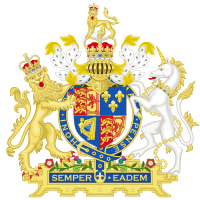 Coat of arms of the concluding Stuart monarch Anne, Queen of Great United kingdom, 1707–1714 | |
| Parent family unit | Clan Stewart |
| Country | Scotland, England, Ireland, Uk |
| Founded | c. 1371 (651 years agone) |
| Founder | Robert II of Scotland (1371–1390) |
| Final ruler | Anne, Queen of Great Uk (1702–1714) |
| Titles | Listing
|
| Dissolution | 1807 (1807) |
| Cadet branches | Listing
|
The House of Stuart, originally Stewart, was a royal house of Scotland, England, Ireland and afterward Great Great britain. The family name comes from the office of High Steward of Scotland, which had been held past the family unit progenitor Walter fitz Alan (c. 1150). The name Stewart and variations had become established equally a family unit name past the time of his grandson Walter Stewart. The first monarch of the Stewart line was Robert II, whose male-line descendants were kings and queens in Scotland from 1371, and of England and Great Britain from 1603, until 1714. Mary, Queen of Scots, was brought up in France where she adopted the French spelling of the proper noun Stuart.
In 1503, James Four married Margaret Tudor, thus linking the royal houses of Scotland and England. Elizabeth I of England died without consequence in 1603, and James IV'due south great-grandson (and Mary's only son) James VI of Scotland succeeded to the thrones of England and Ireland every bit James I in the Union of the Crowns. The Stuarts were monarchs of Britain and Republic of ireland and its growing empire until the decease of Queen Anne in 1714, except for the menstruum of the Republic between 1649 and 1660.[note three]
In total, nine Stewart/Stuart monarchs ruled Scotland lone from 1371 until 1603, the last of which was James VI, before his accession in England. 2 Stuart queens ruled the isles following the Glorious Revolution in 1688: Mary II and Anne. Both were the Protestant daughters of James VII and Ii past his commencement married woman Anne Hyde and the great-grandchildren of James VI and I. Their male parent had converted to Catholicism and his new wife gave birth to a son in 1688, who was to be brought upwardly as a Roman Catholic; so James was deposed by Parliament in 1689, in favour of his daughters. However, neither daughter had any children who survived to adulthood, and so the crown passed to the Business firm of Hanover on the expiry of Queen Anne in 1714 under the terms of the Act of Settlement 1701 and the Human action of Security 1704.
Subsequently the loss of the throne, the descendants of James Seven and II came to be known as the Jacobites and connected for several generations to attempt to reclaim the Scottish and English (and after British) throne as the rightful heirs, though since the early 19th century at that place have been no more active claimants from the Stuart family. The current Jacobite heir to the claims of the historical Stuart monarchs is Franz, Duke of Bavaria, of the Firm of Wittelsbach. The senior living member of the majestic Stewart family unit, descended in a legitimate male person line from Robert Two of Scotland, is Arthur Stuart, 8th Earl Castle Stewart.
Background [edit]
The ancestral origins of the Stuart family unit are obscure—their likely ancestry is traced back to Alan FitzFlaad, a Breton who went to Great Britain not long after the Norman conquest.[ane] Alan had been the hereditary steward of the Bishop of Dol in the Duchy of Brittany;[two] Alan had a good relationship with Henry I of England who awarded him with lands in Shropshire.[2] The FitzAlan family unit rapidly established themselves as a prominent Anglo-Norman noble house, with some of its members serving as High Sheriff of Shropshire.[2] [three] It was the neat-grandson of Alan named Walter FitzAlan who became the first hereditary Loftier Steward of Scotland, while his brother William's family went on to become Earls of Arundel.
When the civil war in the Kingdom of England, known as The Anarchy, bankrupt out between the legitimist claimant Matilda, Lady of the English language, and her cousin who had usurped her, Rex Stephen, Walter had sided with Matilda.[four] Another supporter of Matilda was her uncle David I of Scotland from the House of Dunkeld.[4] After Matilda was pushed out of England into the County of Anjou, essentially failing in her legitimist attempt for the throne, many of her supporters in England fled likewise. It was so that Walter followed David up to the Kingdom of Scotland, where he was granted lands in Renfrewshire and the title for life of Lord High Steward.[4] The next monarch of Scotland, Malcolm Four, made the High Steward championship a hereditary arrangement. While Loftier Stewards, the family unit were based at Dundonald, South Ayrshire, between the 12th and 13th centuries.
History [edit]
| | | |
|---|---|---|
| | | |
| | | |
| | | |


The sixth Loftier Steward of Scotland, Walter Stewart (1293–1326), married Marjorie, daughter of Robert the Bruce, and too played an of import function in the Battle of Bannockburn gaining further favour. Their son Robert was heir to the House of Bruce, the Lordship of Cunningham and the Bruce lands of Bourtreehill; he somewhen inherited the Scottish throne when his uncle David II died childless in 1371.
In 1503, James IV attempted to secure peace with England by marrying King Henry Vii's daughter, Margaret Tudor. The nascence of their son, later on James Five, brought the House of Stewart into the line of descent of the Firm of Tudor, and the English throne. Margaret Tudor later married Archibald Douglas, sixth Earl of Angus, and their daughter, Margaret Douglas, was the female parent of Henry Stuart, Lord Darnley. In 1565, Darnley married his half-cousin Mary, Queen of Scots, the girl of James 5. Darnley'due south begetter was Matthew Stewart, quaternary Earl of Lennox, a member of the Stewart of Darnley branch of the House. Lennox was a descendant of Alexander Stewart, 4th High Steward of Scotland, besides descended from James 2, being Mary's heir presumptive. Thus Darnley was too related to Mary on his father'southward side and considering of this connection, Mary's heirs remained part of the Business firm of Stuart. Following John Stewart of Darnley's ennoblement for his function at the Battle of Baugé in 1421 and the grant of lands to him at Aubigny and Concressault, the Darnley Stewarts' surname was gallicised to Stuart.
Both Mary, Queen of Scots, and Lord Darnley had strong claims on the English language throne through their mutual grandmother Margaret Tudor. This eventually led to the accretion of the couple'south only child James as King of Scotland, England, and Republic of ireland in 1603. All the same, this was a personal union, as the three Kingdoms shared a monarch, only had split up governments, churches, and institutions. Indeed, the personal matrimony did not forestall an armed conflict, known every bit the Bishops' Wars, breaking out between England and Scotland in 1639. This was to become role of the wheel of political and military conflict that marked the reign of Charles I of England, Scotland and Ireland, culminating in a serial of conflicts known as the War of the Iii Kingdoms. The trial and execution of Charles I past the English Parliament in 1649 began 11 years of republican government known as the English language Interregnum. Scotland initially recognised the tardily King's son, also called Charles, as their monarch, before being subjugated and forced to enter Cromwell's Commonwealth by General Monck's occupying ground forces. During this menstruation, the chief members of the House of Stuart lived in exile in mainland Europe. The younger Charles returned to Great britain to assume his iii thrones in 1660 as "Charles 2 of England, Scotland and Ireland", but dated his reign from his father's death eleven years earlier.
In feudal and dynastic terms, the Scottish reliance on French back up was revived during the reign of Charles II, whose own female parent was French. His sister Henrietta married into the French royal family. Charles Ii left no legitimate children, but his numerous illegitimate descendants included the Dukes of Buccleuch, the Dukes of Grafton, the Dukes of Saint Albans and the Dukes of Richmond.

These French and Roman Catholic connections proved unpopular and resulted in the downfall of the Stuarts, whose mutual enemies identified with Protestantism and because James Seven and Two offended the Anglican establishment by proposing tolerance not only for Catholics just for Protestant Dissenters. The Glorious Revolution caused the overthrow of King James in favour of his son-in-law and his daughter, William and Mary. James continued to claim the thrones of England and Scotland to which he had been crowned, and encouraged revolts in his name, and his grandson Charles (also known every bit Bonnie Prince Charlie) led an ultimately unsuccessful ascent in 1745, ironically becoming symbols of conservative rebellion and Romanticism. Some arraign the identification of the Roman Catholic Church with the Stuarts for the extremely lengthy filibuster in the passage of Cosmic emancipation until Jacobitism (as represented past direct Stuart heirs) was extinguished; however it was equally likely to be caused by entrenched anti-Catholic prejudice amongst the Anglican institution of England. Despite the Whig intentions of tolerance to be extended to Irish subjects, this was non the preference of Georgian Tories and their failure at compromise played a subsequent role in the nowadays division of Republic of ireland.[ citation needed ]
Present day [edit]
The Royal House of Stuart became extinct with the decease of Cardinal Henry Benedict Stuart, brother of Charles Edward Stuart, in 1807. Duke Francis of Bavaria is the current senior heir.[5] Withal, Charles 2 had a number of illegitimate sons whose surviving descendants in the male line include Charles Gordon-Lennox, 11th Duke of Richmond; Henry FitzRoy, twelfth Knuckles of Grafton; Murray Beauclerk, 14th Duke of St Albans; and Richard Scott, tenth Knuckles of Buccleuch. In addition, James II's illegitimate son, James FitzJames, 1st Duke of Berwick, founded the House of FitzJames comprising two branches, one in France and one in Spain. The concluding of the French branch died in 1967; the senior heir of James Two'south male person-line descendants is Jacobo Hernando Fitz-James Stuart, 20th Duke of Peñaranda de Duero.
List of monarchs [edit]
Monarchs of Scotland [edit]
| Portrait | Name | From | Until | Relationship with predecessor |
|---|---|---|---|---|
 | Robert 2 | 22 Feb 1371 | xix April 1390 | nephew[6] of David Two who died without issue. Robert's mother Marjorie Bruce was daughter of Robert I. |
 | Robert 3 | 19 April 1390 | 4 April 1406 | son of Robert Ii. |
 | James I | 4 April 1406 | 21 Feb 1437 | son of Robert III. |
 | James II | 21 February 1437 | 3 August 1460 | son of James I. |
 | James III | 3 Baronial 1460 | xi June 1488 | son of James Two. |
 | James Iv | 11 June 1488 | ix September 1513 | son of James Iii. |
 | James Five | 9 September 1513 | 14 December 1542 | son of James Iv. |
 | Mary | 14 Dec 1542 | 24 July 1567 | girl of James V. |
 | James VI | 24 July 1567 | 27 March 1625 | son of Mary, Queen of Scots. |
Monarchs of England, Scotland and Ireland [edit]
From the Acts of Union 1707, which came into effect on 1 May 1707, the last Stuart monarch, Anne, became Queen of Neat Britain and Ireland.
| Portrait | Proper name | From | Until | Relationship with predecessor |
|---|---|---|---|---|
 | James Half dozen and I | 24 March 1603 | 27 March 1625 | Great-Bang-up grandson of Henry 7 of England. King of Scotland lone until inheriting the titles King of England and Republic of ireland, including claim to France from the extinct Tudors. |
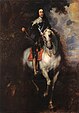 | Charles I | 27 March 1625 | 30 January 1649 (executed) | son of James VI and I |
 | Charles Two | thirty January 1649 (de jure); 2 May 1660 (de facto) | six February 1685 | son of Charles I. Prohibited by Parliament from assuming the throne during a republican period of government known as the Commonwealth of England, only then accepted as king in 1661. |
 | James VII and II | vi February 1685 | xi December 1688 | brother of Charles II, who died without legitimate event. Son of Charles I. Overthrown at the Revolution of 1688. Died in 1701. |
 | Mary Ii | 13 February 1689 | 28 December 1694 | daughter of James II & VII, who was still live and pretending to the throne. Co-monarch was William Iii & II who outlived his wife. |
 | Anne | eight March 1702 | ane Baronial 1714 | sis of Mary II. girl of James Ii & Seven. Proper noun of land changed to United kingdom with the political Acts of Spousal relationship 1707, though family has used title since James I & Six. Died childless, rights laissez passer to House of Hanover. |


Family unit tree [edit]
Round provided a family tree[7] to embody his essential findings, which is adapted below.
| Alan, Dapifer Dolensis (Seneschal or Steward of Dol) | |||||||||||||||||||||||
| Alan, Dapifer Dolensis, Took part in First Cause, 1097. | Flaald Occurs at Monmouth, 1101/2 | Rhiwallon Monk of St Florent. | |||||||||||||||||||||
| Alan Fitz Flaad, Founder of Sporle Priory | |||||||||||||||||||||||
| Jordan Fitz Alan, Dapifer in Brittany, Benefactor of Sele Priory. | William Fitz Alan, Lord of Oswestry Founder/distributor of Haughmond Abbey, Died 1160 | Walter fitz Alan Dapifer Regis Scotiae, Founder of Paisley Abbey, Died 1177 | |||||||||||||||||||||
| Alan Fitz Hashemite kingdom of jordan, Dapifer Dolensis. | William Fitz Alan II, Lord of Oswestry and Clun | Alan the Steward Senescallus Regis Scotiae | |||||||||||||||||||||
Origin [edit]
- Alan fitz Flaad
- William FitzAlan, Lord of Oswestry
- William Fitz Alan, 1st Lord of Oswestry and Clun
- William Fitz Alan, 2nd Lord of Oswestry and Clun
- John Fitzalan, Lord of Oswestry
- John FitzAlan, 6th Earl of Arundel
- House of FitzAlan
- John FitzAlan, 6th Earl of Arundel
- William Fitz Alan, 1st Lord of Oswestry and Clun
- Hashemite kingdom of jordan fitz Alan, Seneschal of Dol
- Walter fitz Alan, 1st Loftier Steward of Scotland
- Alan fitz Walter, 2nd High Steward of Scotland
- Walter Stewart, 3rd Loftier Steward of Scotland
- Alexander Stewart, quaternary High Steward of Scotland
- James Stewart, fifth High Steward of Scotland
- Walter Stewart, 6th High Steward of Scotland
- Robert II of Scotland
- John Stewart of Ralston
- Walter Stewart, 6th High Steward of Scotland
- John Stewart of Bonkyll
- Alexander Stewart of Bonkyll
- Earls of Angus (extinct 1361)
- Alan Stewart of Dreghorn
- Stewart of Darnley
- Earls of Lennox
- Stewart of Garlies
- Earls of Galloway
- Stewart of Burray
- Stewart of Physgill (Phisgal)
- Stewart of Minto
- Lords Blantyre
- Stewart of Tongrie
- Stewart of Barclye
- Stewart of Darnley
- Walter Stewart of Garlies and Dalswinton
- John Stewart of Dalswinton
- Walter Stewart of Garlies and Dalswinton
- John Stewart of Dalswinton
- James Stewart of Pearston
- Stewart of Pearston
- Stewart of Lorn
- Clan Stewart of Appin
- Earls of Atholl
- Earls of Buchan
- Earls of Traquair (illegitimate)
- Stewart of Lorn
- Stewart of Pearston
- John Stewart of Daldon
- Robert Stewart of Daldowie
- Alexander Stewart of Bonkyll
- James Stewart, fifth High Steward of Scotland
- Walter Bailloch
- Earls of Menteith
- Robert Stewart, Lord of Darnley
- Alexander Stewart, quaternary High Steward of Scotland
- Walter Stewart, 3rd Loftier Steward of Scotland
- Alan fitz Walter, 2nd High Steward of Scotland
- Simon fitz Alan
- Clan Boyd
- William FitzAlan, Lord of Oswestry
House of Stewart [edit]
- Robert 2 of Scotland
- Robert III of Scotland
- David Stewart, Duke of Rothesay
- James I of Scotland
- Alexander Stewart, Duke of Rothesay
- James II of Scotland
- James 3 of Scotland
- James IV of Scotland
- James, Knuckles of Rothesay
- Arthur Stewart, Knuckles of Rothesay
- James 5 of Scotland
- James, Duke of Rothesay
- Arthur, Duke of Albany
- Mary, Queen of Scots
- Alexander Stewart, Duke of Ross
- James Stewart, Duke of Ross
- John Stewart, Earl of Mar
- James IV of Scotland
- Alexander Stewart, Duke of Albany
- Alexander Stewart, Bishop of Moray
- John Stewart, Knuckles of Albany
- David Stewart, Earl of Moray
- John Stewart, Earl of Mar
- James 3 of Scotland
- Sir John Stewart (illegitimate)
- Stewart of Ballechin
- Walter, Lord of Fife
- Robert Stewart, Duke of Albany
- Murdoch Stewart, Duke of Albany
- Robert Stewart
- Walter Stewart
- Lords Avandale
- Lords Stuart of Ochiltree
- Barons Castle Stewart
- Earls Castle Stewart
- Barons Castle Stewart
- Lords Stuart of Ochiltree
- Lords Avandale
- Alasdair Stewart
- James Mor Stewart
- James "Beag" Stewart (illegitimate)
- Stewart of Balquhidder
- Stewart of Ardvorlich
- Stewart of Glen Buckie
- Stewart of Gartnafuaran
- Stewart of Annat
- Stewart of Balquhidder
- James "Beag" Stewart (illegitimate)
- John Stewart, Earl of Buchan
- Robert Stewart, Earl of Ross
- Murdoch Stewart, Duke of Albany
- Alexander Stewart, Earl of Buchan, the Wolf of Badenoch
- Illegitimate sons
- Stewart of Atholl
- Illegitimate sons
- David Stewart, Earl of Strathearn
- Walter Stewart, Earl of Atholl
- Alan Stewart, 4th Earl of Caithness
- David Stewart, Chief of Atholl
- John Stewart, Sheriff of Bute (illegitimate)
- Clan Stuart of Bute
- Robert III of Scotland
Business firm of Stuart [edit]
Descended from the Stewarts of Darnley (Stewarts of Lennox)
- Henry Stuart, Lord Darnley, husband of Mary, Queen of Scots
- James Half dozen and I
- Henry Frederick, Prince of Wales
- Charles I of England
- Charles II of England
- James Scott, 1st Duke of Monmouth (illegitimate)
- Dukes of Buccleuch
- Charles FitzCharles, 1st Earl of Plymouth (illegitimate)
- Charles FitzRoy, 2d Knuckles of Cleveland (illegitimate)
- Dukes of Cleveland (extinct 1774)
- Henry FitzRoy, 1st Duke of Grafton (illegitimate)
- Dukes of Grafton
- George FitzRoy, 1st Duke of Northumberland (illegitimate)
- Charles Beauclerk, 1st Duke of St Albans (illegitimate)
- Dukes of St Albans
- Charles Lennox, 1st Duke of Richmond (illegitimate)
- Dukes of Richmond, Lennox and Gordon
- James Scott, 1st Duke of Monmouth (illegitimate)
- James II of England
- Charles Stuart, Duke of Cambridge
- James Stuart, Duke of Cambridge
- Charles Stuart, Duke of Kendal
- Edgar, Duke of Cambridge
- Charles Stuart, Duke of Cambridge
- James Francis Edward Stuart
- Charles Edward Stuart
- Henry Benedict Stuart
- James FitzJames, 1st Duke of Berwick (illegitimate)
- Business firm of FitzJames
- Dukes of Berwick
- Dukes of Fitz-James (extinct 1967)
- Business firm of FitzJames
- Henry FitzJames (illegitimate)
- Henry Stuart, Duke of Gloucester
- Charles II of England
- Robert Stuart, Duke of Kintyre and Lorne
- James Half dozen and I
Meet besides [edit]
- Jacobitism, for more on the legitimist House of Stuart, following the Glorious Revolution
- John Barbour, the first Stewart court poet and genealogist
- Listing of Scottish monarchs
- List of British monarchs
- Association Stewart
- Barony and Castle of Corsehill Stewarton in Ayrshire and the Stuart connectedness
- Armorial of the Business firm of Stuart
Notes [edit]
- ^ titular claim rather than de facto
- ^ Title assumed past James V of Scotland, in correspondence with Irish gaelic chieftains, equally a challenge to Henry Viii, who had recently been declared 'King of Ireland.'
- ^ The Earls of Galloway are the senior surviving line of the Stuarts. They are descended from a line which originated from the second son of Alexander Stewart, quaternary High Steward of Scotland, and are not members of the Stewart/Stuart royal line; still, they are part of the peerage.
References [edit]
- ^ "J.H. Round: The Origin of the Stewarts: Function i". MedievalGenealogy.org.uk. Retrieved on 13 November 2008.
- ^ a b c Bartlett, England Nether the Norman and Angevin Kings, 1075–1225, 544.
- ^ Lieber, Encyclopædia Americana, xxx.
- ^ a b c King, The Anarchy of King Stephen's Reign, 249.
- ^ Alleyne, Richard; de Quetteville, Harry (7 April 2008). "Act repeal could make Franz Herzog von Bayern new King of England and Scotland". Daily Telegraph. Archived from the original on 8 April 2008. Retrieved 22 June 2008.
- ^ The Oxford Dictionary of National Biography
- ^ "Studies in peerage and family history".
Sources [edit]
- King, Edmund (1994). The Anarchy of King Stephen's Reign. Oxford University Press. ISBN0-xix-820364-0.
- Barrow, G. W. Southward. (2003). The Kingdom of the Scots. Edinburgh: Edinburgh University Press. ISBN0-7486-1802-iii.
- Barrow, G. W. Southward. (2004). "Stewart family (per. c.1110–c.1350)". Oxford Dictionary of National Biography. Oxford Lexicon of National Biography (online ed.). Oxford University Press. doi:10.1093/ref:odnb/49411. Retrieved 11 Oct 2010. (Subscription or UK public library membership required.)
- Round, J. Horace (1901). Studies in Peerage and Family History. Westminster, London: Archibald Constable & Co Ltd.
Farther reading [edit]
- Addington, Arthur C. The Royal Firm of Stuart: The Descendants of Rex James VI of Scotland (James I of England). 3v. Charles Skilton, 1969–76.
- Cassavetti, Eileen. The Lion & the Lilies: The Stuarts and France. Macdonald & Jane's, 1977.
External links [edit]
- Official website of the Stewarts of Argyll
Source: https://en.wikipedia.org/wiki/House_of_Stuart
0 Response to "Members of an Important Family of Kings in England Were Called:"
Post a Comment